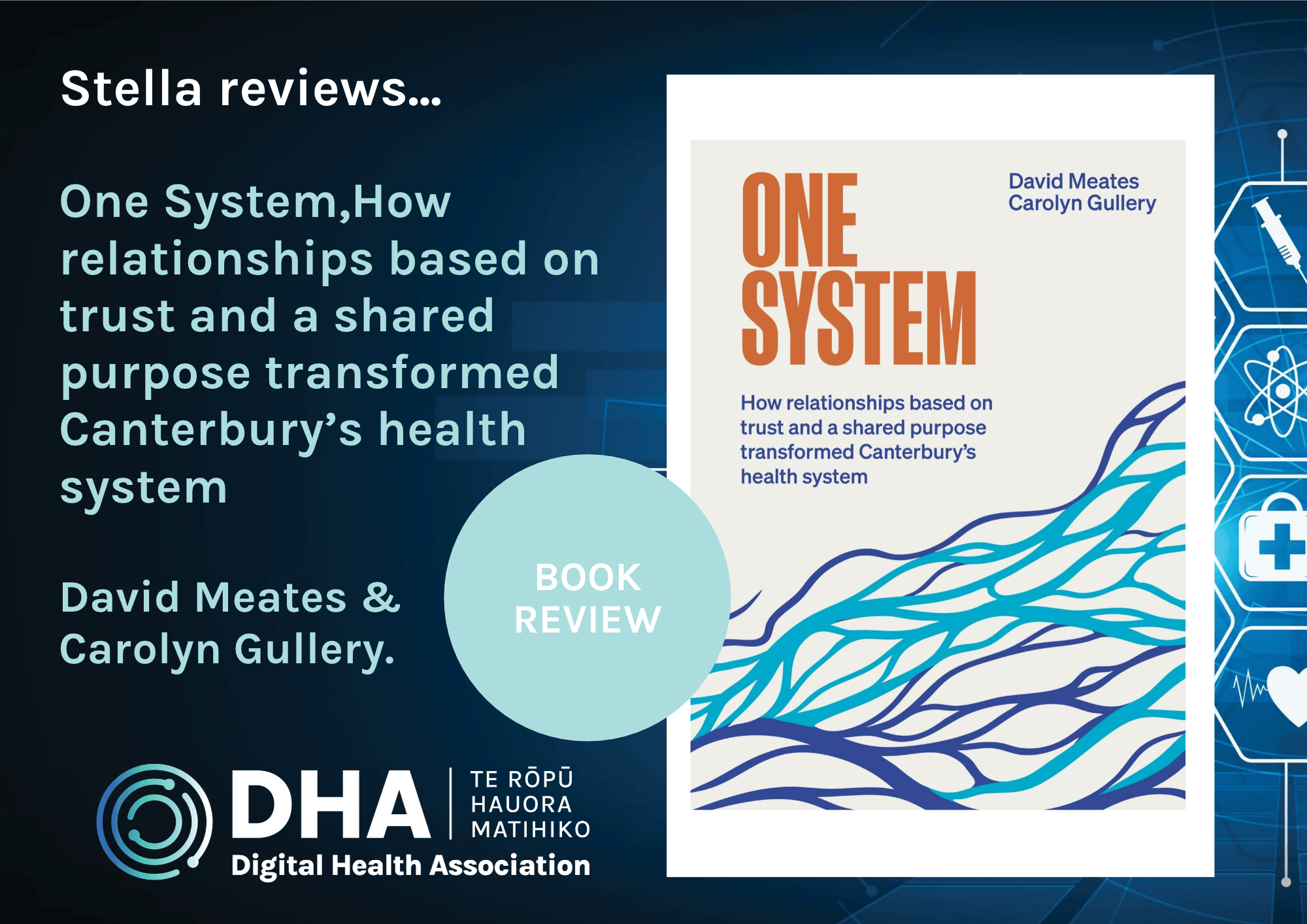
How relationships based on trust and a shared purpose transformed Canterbury’s health system, by David Meates and Carolyn Gullery.
Few books on health system transformation are written by the people who carried the responsibility for it. One System is. David Meates, former Chief Executive of the Canterbury and West Coast District Health Boards, and Carolyn Gullery, who led planning, funding and decision support, give an inside account of how Canterbury moved between 2007 and 2020 from fragmented services towards a system organised around people rather than institutions.
I opened it with more than professional curiosity. For ten of those years, I sat at the Canterbury executive table as Chief Digital Officer and Executive Director Allied Health, Technical and Scientific. I also led the innovation unit that supported people with good ideas to improve care. This is a review, but it is also a reflection from someone who was there.
The authors describe one aim held steady for more than a decade: to act as one system. Three goals anchored it. Support people and whānau to stay well and take more responsibility for their own health. Strengthen primary care and community services so people have continuity close to home. Free up hospital specialists for episodic events, complex care and advice to primary care.
At the heart of the book is a simple question: what if we designed the health system around people, not organisations? The authors give it a face in Agnes, the person the whole system was drawn around. A visualisation, based on the Redbridge Trust model and developed by the Canterbury Health System, put her at the centre and helped 18,000 people see one system rather than competing parts. I remember how powerful that shift was. The conversation moved from whose service or budget was affected to what Agnes needed, and who around the table could help.
The book follows that work through progress, setbacks and crises. It does not pretend there was a perfect master plan. Its central argument is that lasting change grew from trust, shared purpose, clinical leadership, better use of data and funding, and alignment across hospitals, general practice and community services, not from restructuring or tighter control. The outcomes are set out plainly and are real.
The foreword by Professor Sir Chris Ham and the afterword by Dr Graham Scott give the story international weight. The Canterbury earthquakes, the 2019 mosque attacks and COVID-19 showed whether the relationships were real.
What struck me most is how accurately the book captures the texture of the time. The clinical leaders’ call that we need the whole system working for the whole system to work is how it felt in the room. Decisions were rarely about protecting an organisation or a profession. They were about what the person at the centre of the picture needed from all of us.
The earthquakes remain the clearest example. As incident controller for vulnerable people, I saw how quickly boundaries fell away. Nobody asked whose job it was or who held the budget. People who already knew and trusted each other picked up the phone and solved the problem. The book is right that this was not luck. Those relationships had been built over years, long before anyone needed them.
I also recognise the humility the authors bring. Colleagues, innovators , clinical leaders and community members were invited to shape the direction, not just to implement it. Being trusted to lead within a shared purpose changed what I felt I could take responsibility for. I came away convinced that culture is the work, not what surrounds it. Those years were demanding, and the book does not romanticise them. Reading about the trade-offs brought back how hard it was to hold a vision steady while demand kept growing and the ground, literally, kept moving.
In my current role leading the Digital Health Association, I am asked constantly what good looks like for digital, data and innovation. One System reminds me that technology does not transform a health system on its own. Interoperability, shared records and good data matter, but they work when they serve a shared purpose and a trusted network of people. No single organisation can solve the problem alone, and that is the posture I hope our members and partners bring to the national conversation on digital foundations, standards and procurement.
This is not a blueprint, and the authors say so. It will suit those who lead, govern or work in complex systems and want to understand what it takes to change them: clinicians, executives, board members, policymakers, and technology and industry partners. It will also resonate with anyone who lived through the Canterbury years.
I recommend it warmly. My thanks to David and Carolyn for putting the story on the record, and to the thousands of colleagues who made it real. For those of us who were there, it is a generous and honest reminder of what is possible when people stop defending boundaries and take collective responsibility together.